COS-7 Cell Line Origin
COS-7 is one of several types of COS (CV-1 in Origin with SV40 genes) cell lines commonly used today. The COS-7 cell line was established by Professor Yakov Gluzman in 1981 and is derived from a CV-1 African green monkey fibroblast cell line by transformation with a mutant strain of Simian Virus 40 (SV40) that codes for the wild-type T-antigen. COS cell lines are used to study SV40 monkey viruses and as a common mammalian production cell for recombinant proteins, such as antibodies and signaling molecules. COS-7 cells most resemble human fibroblast cells and are thus often called COS-7 monkey fibroblast or COS-7 fibroblast-like cells. For added clarification, COS-7 cells are not primary cells.
COS-7 Cell Line Characteristics
The result of the transformation of CV-1 to create the COS-7 cell line was the expression of the SV40 T-antigen for which it retains and is susceptible to SV40, which grows lytically within the kidney cells. The replication of the A209 virus at 40°C is also permitted, as are SV40 mutants, as long as mutations (i.e. insertions, deletions, mutations) are in the early regions of the viral genome. Thus, COS is an acronym for CV-1 in Origin, carrying SV40.
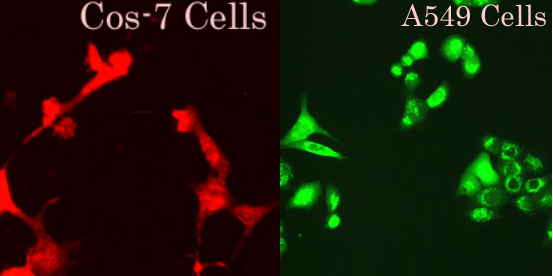
In culture, COS-7 cells characteristically display adherent growth to glass and plastic surfaces and are fibroblast-like. The combination of fibroblastic-like growth and virus susceptibility make COS-7 a great choice for transfection experiments for DNA plasmids and mutations to the SV40 virus. The SV40 virus continues to be utilized due to its putative involvement in human cancers.
Links
Wikipedia article on Cos-7 cells – COS cells (Wikipedia)
Purchase Cos-7 cells – ATCC
In Vitro Cos-7 Transfection Reagent from Altogen Biosystems
In Vivo Cos7 siRNA transfection kit – In Vivo Transfection Kits
Generation of Stably Expressing Cell Lines in 28 Days
Stable RNAi Cell Line Generation: Stable Gene Knockdown
COS-7 Transfection Reagent (Kidney Cells, CRL-1651)
COS-7 Cells I COS-7 Cell Culture Protocol I COS-7 Transfection Information I Get COS-7 Transfection Reagent